Looking for a dentist in Garia? Here’s exactly what happens once you walk through the door.
You have booked the appointment three times. You have cancelled it three times.
Or maybe you never booked at all. You just decided you’d go “when it really starts hurting,” and that day keeps not arriving — even though the tooth has been sending small signals for months.
If that’s you, this blog isn’t going to tell you to be brave. It’s going to do something more useful: tell you exactly what happens, minute by minute, so there’s nothing left to imagine.
Most dental fear isn’t fear of pain. It’s fear of the unknown — of not knowing what that sound is, what they’re about to do, or how much it will cost when you walk out. Take away the unknown, and the fear gets much smaller.
| QUICK ANSWER A modern first dental visit involves no drilling and usually no treatment at all. It’s a conversation, a visual examination, a chairside digital X-ray that takes seconds, a 3D scan of your teeth with a small camera wand, and a written treatment plan with costs. You can stop at any point. At Digi-Dent Care in Garia, Kolkata, nothing is done to your teeth on day one unless you are in pain and want relief immediately. |
Table of Contents
First — you’re not being dramatic
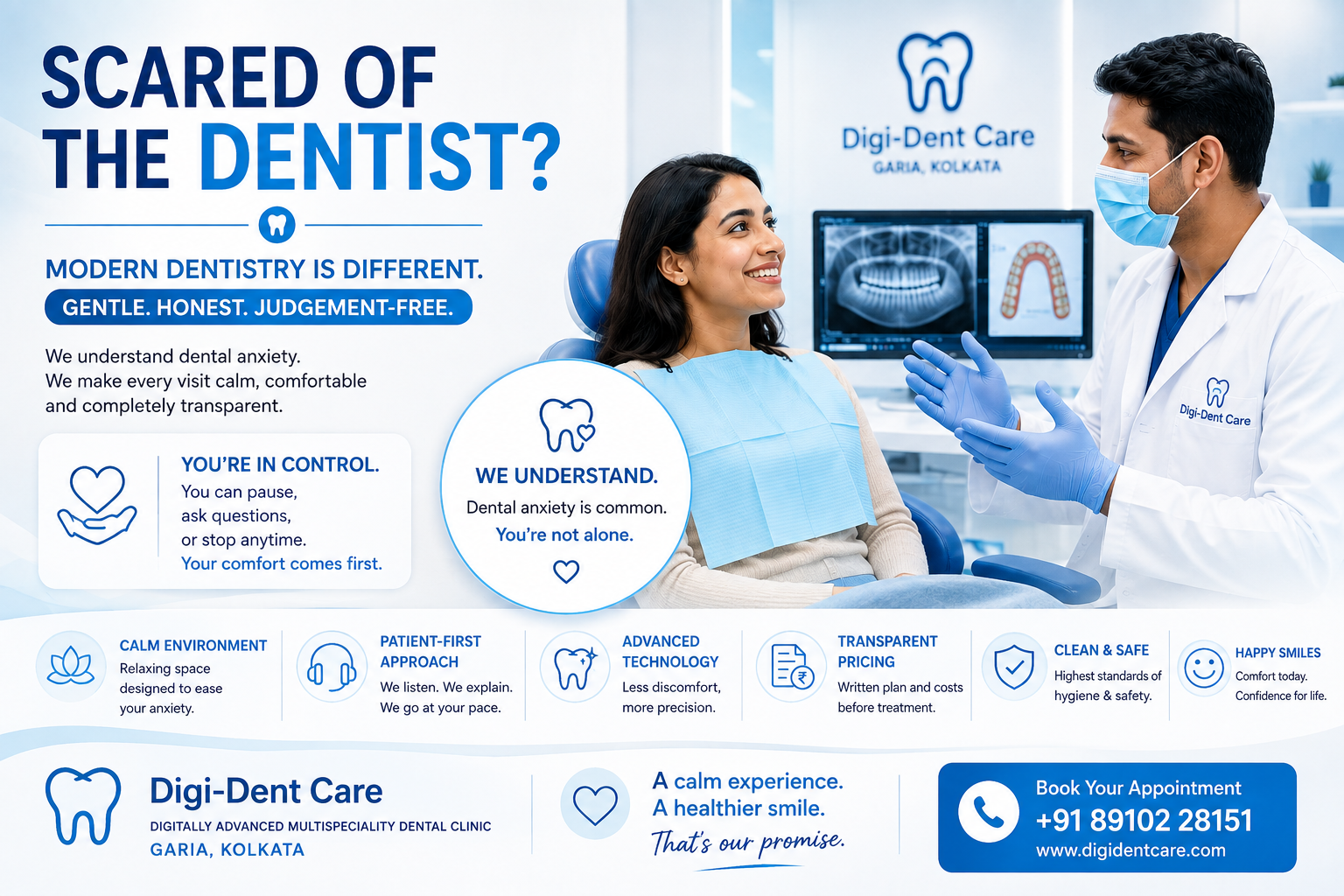
Dental anxiety is one of the most common fears there is. Dentists see it every single day. It shows up in ordinary ways:
- Rescheduling the appointment more than once
- Only going when the pain becomes unbearable
- A racing heart in the waiting room
- Not sleeping properly the night before
- Feeling embarrassed about how long it’s been
None of this makes you difficult or childish. It makes you normal. And it’s worth saying out loud at reception when you book — a good clinic will slow down for you. The American Dental Association confirms dental anxiety is one of the most common barriers to care, which is exactly why modern, judgment-free visits matter.
Where the fear usually comes from — and what’s actually changed
Almost every anxious patient traces their fear to one of these six things. Here’s what a well-equipped modern clinic does about each one.
| WHAT SCARES PEOPLE | WHAT’S CHANGED TODAY |
| The drilling sound | Modern handpieces are far quieter, and many small cavities are caught early enough to need only a short, shallow filling |
| The injection | Numbing gel is applied first, and anaesthetic is delivered slowly. Most patients feel pressure, not a sting |
| Not knowing what’s happening | The dentist explains each step before it starts, and you can see your own teeth on the screen |
| Gagging on impression trays | A 3D intraoral scanner replaces the putty tray completely. A small wand, no material in your mouth |
| Being judged for neglected teeth | Dentists are trained to treat, not to lecture. Nobody in that room is surprised by anything |
| An open-ended bill | A written estimate is given before treatment begins, not after |
Most of what people fear about dentistry comes from a version of it that’s decades old — or from a story someone else told them.
What actually happens in your first visit
This is the part nobody explains properly. Here it is, in order.
MINUTES 0–5
You talk. You don’t sit in the chair.
The visit starts with a conversation. What’s bothering you, how long it’s been, what happened last time, what you’re worried about. If you want to say “I’m terrified and I haven’t been in eight years,” say it here. It changes how the rest of the appointment is handled.
MINUTES 5–10
A look, with no instruments
The dentist checks your teeth, gums and bite using a mirror and light. Nothing sharp, nothing that vibrates. This is only to see what’s there.
MINUTES 10–13
Chairside digital X-ray
The sensor is placed for a few seconds and the image appears on the screen immediately. There’s no film, no waiting, and radiation is significantly lower than with older X-ray systems. You’ll be looking at your own X-ray within moments of it being taken.
MINUTES 13–20
3D intraoral scan
If your case needs it, a small camera wand is passed over your teeth and builds an accurate 3D model on the screen. This is the step that replaces the old impression tray full of putty — the one that made so many people gag. Nothing goes into your mouth except the wand.
MINUTES 20–30
You see everything, on screen
Your teeth, magnified. The dentist points out what’s healthy, what needs attention now, and what can simply be watched. This is usually the moment anxious patients relax, because the problem stops being a mystery.
MINUTES 30–40
A written plan, with costs
You get a plan: what needs doing, in what order, roughly how long it takes, and what it costs. You take it home. You decide.
And that’s the visit. No drilling. No treatment. Unless you’re in pain right now and want relief today — in which case, that’s the priority and everything else waits.
The stop signal: you’re allowed to pause
Here’s the single most useful thing an anxious patient can do, and almost nobody knows to ask for it.
Before treatment starts, agree on a hand signal. Raise your left hand and everything stops — instruments out, suction off, chair up if you need it. No explanation required, no questions asked, no irritation.
It sounds small. It isn’t. Most dental fear is really fear of losing control — of being stuck, mouth open, unable to speak, while something happens to you. A stop signal hands that control back. Many patients say they never actually needed to use it. Just knowing it was there was enough.
Ask for it. Any dentist worth seeing will say yes immediately.
7 things that genuinely help before your appointment
| DO THIS | WHY IT WORKS |
| Say you’re nervous when you book | Reception can flag it and allot extra time |
| Take the first slot of the day | Less waiting-room time, and nothing running late |
| Eat something beforehand | Low blood sugar makes anxiety physically worse |
| Skip the coffee that morning | Caffeine amplifies a racing heart, and you’ll read that as panic |
| Bring headphones | Music removes the sound that bothers people most |
| Bring someone with you | A friend in the waiting room helps more than you’d expect |
| Write your questions down | Anxiety wipes memory clean. A note means you’ll actually ask them |
“My teeth are in bad shape and I’m embarrassed”
This is the reason most often given for staying away — and it’s the one worth addressing directly.
Dentists in busy clinics see neglected mouths every day of their working lives. Broken teeth, heavy tartar, gaps, gum disease, work that was started years ago and never finished. It is completely routine. Nobody is going to react, and nobody is going to lecture you about the years you missed.
There’s also a practical point: shame keeps people away, staying away makes things worse, and worse teeth deepen the shame. That loop only breaks in one place — the first appointment. After that, it’s just a treatment plan.
What waiting actually costs
Dental problems don’t hold still. They move in one direction.
| STAGE | WHAT IT USUALLY NEEDS | WHAT IT TAKES |
| Small cavity | A filling | One short visit |
| Deep cavity reaching the nerve | Root canal treatment | Often one sitting with rotary endodontics |
| Infected, badly broken tooth | Root canal plus a crown, or extraction | Several visits |
| Tooth lost | Implant or bridge | Months, and considerably more cost |
Every one of those stages began as the one above it. The appointment you’re avoiding is almost always the cheapest and quickest one you will ever have.
If you have children, this matters twice
Children learn fear by watching. A parent who says “don’t worry, it’ll only hurt a little” has just introduced the idea of hurt. A parent who is visibly tense in the waiting room teaches more than any words.
The most useful thing you can do for your child’s dental future is to get your own first visit over with, and to keep the language neutral. Preventive check-ups, fluoride application and sealants are quick and painless — and a child whose early visits involve nothing frightening usually grows up without this fear at all.
Book a Visit with a Trusted Dentist in Garia
If it’s been years, start with a consultation. No treatment, no commitment — just information and a plan you can think about at home.
| DIGI-DENT CARE Digitally Advanced Multispeciality Dental Clinic ADDRESS Saptatari, A/41, New Scheme, Goshtotala, Garia, Kolkata – 700084 PHONE +91 89102 28151 EMAIL digidentcare24@gmail.com WEBSITE www.digidentcare.com Serving Garia, Garia Station, Naktala, Patuli, Baghajatin, Bansdroni, Jadavpur, Kamalgazi and Sonarpur. |
Ready when you are: book your consultation, browse all our dental services, or meet our doctors at Digi-Dent Care.
Frequently asked questions
1. Is dental treatment still painful?
For the great majority of routine procedures, no. Local anaesthesia is applied after a numbing gel and delivered slowly, so most patients report pressure and vibration rather than pain. You may feel soreness for a day or two after certain procedures, which is normal healing. If you feel anything sharp during treatment, say so — more anaesthetic can be given immediately.
2. I haven’t been to a dentist in years. Will I be judged?
No. Long gaps are extremely common and dentists see them constantly. The examination is about what your mouth needs now, not about the years behind it. If any dental team makes you feel small about it, that’s a reason to change clinics — not a reason to stay away from dentistry.
3. Can I ask the dentist to stop in the middle of treatment?
Yes, always. Agree on a raised-hand signal before starting, and use it whenever you need a break — to breathe, to swallow, to ask a question, or simply to sit up for a minute. Treatment stops. This is a normal part of caring for anxious patients, not an inconvenience.
4. Is sedation available for very anxious patients?
Most anxiety is managed successfully with good local anaesthesia, clear explanation, slower pacing and planned breaks. For patients whose anxiety is severe, additional options may be considered depending on the case and medical history. Raise it during your consultation and the team will tell you what is suitable and available for you.
5. What’s the least stressful appointment to start with?
A consultation. It involves no drilling and no treatment — just an examination, a digital X-ray, and a discussion. Many nervous patients follow it with a routine scaling and polishing, which is a short, low-intensity way to get used to the chair before anything bigger is planned.
6. How do I stop my child from becoming scared of the dentist?
Take them for a first check-up before anything hurts, so their earliest memory of a clinic is an uneventful one. Avoid words like “hurt,” “pain,” “needle” and “brave” — they plant the idea. Don’t promise it won’t hurt; say instead that the dentist is going to count their teeth. And book your own visit too, because children read your body language in the waiting room.
Medically reviewed by the clinical team at Digi-Dent Care, Garia, Kolkata — Dr. Sumit Kr. Roy (BDS, MDS – Prosthodontics & Implantology) and Dr. Surupa Dutta (BDS, MDS – Periodontology & Implantology).
This blog is for general information and awareness. It is not a substitute for an in-person dental examination or personalised advice. If anxiety is affecting your daily life more broadly, it is worth speaking to your doctor as well.