As the best dental clinic in Garia, we know crooked teeth rarely happen overnight. Most people don’t wake up one morning that way. It happens slowly. A tooth turns a little. A gap opens up. Food starts getting stuck in the same spot every single day. Because the change is slow, it feels normal — until chewing, cleaning or smiling starts to feel like work.
Here’s the part many patients don’t expect: misaligned teeth are not only about looks. They change how you bite, how well you can clean your teeth, and how much pressure your jaw joint takes every day.
At Digi-Dent Care, Garia — often searched for as the best dental clinic in Garia — we see many patients who waited years before asking a simple question: do I actually need braces? This blog will help you answer that at home, in plain language.
| QUICK ANSWER You may need orthodontic treatment if your teeth overlap, have growing gaps, don’t meet properly when you bite, or if you get jaw pain, repeated cheek bites, or uneven tooth wear. A single check-up with digital scanning and an X-ray can confirm whether you need braces, aligners, or simply monitoring. Children can be checked from around age 7; adults have no upper age limit. |
Table of Contents
What is orthodontic treatment, in simple words?
Orthodontics is the part of dentistry that moves teeth and guides jaw growth into the right position.
It uses gentle, steady pressure — from braces, wires or clear aligners — to shift teeth slowly through the bone. The goal isn’t only a straight smile. It’s a bite that works properly, so your teeth share the chewing load evenly and last longer.
Try this 2-minute mirror test at home
Stand in front of a mirror in good light and check:
- Bite your back teeth together. Do your upper front teeth cover the lower ones almost completely?
- Do your lower front teeth sit in front of the upper ones?
- When your back teeth touch, is there still a gap between your front teeth?
- Do any teeth overlap, twist, or sit out of line?
- Run your tongue along the biting edges — do some teeth feel flat or chipped?
- Is there one spot where food gets stuck after every meal?
- Do your lips close comfortably, without you pushing them together?
Ticked two or more boxes? It’s worth getting a professional opinion. This test spots the obvious things — it can’t see root position, jaw joint health or hidden crowding.
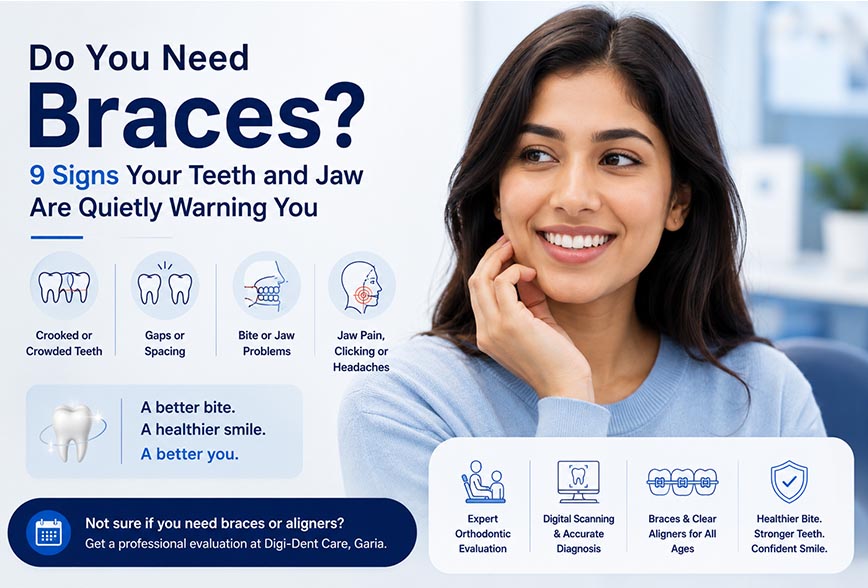
9 signs you should not ignore
SIGN 01
Teeth that overlap, twist or look crowded
Crowding happens when the jaw doesn’t have enough room for all the teeth, so they push past each other.
The real problem is hygiene. A toothbrush bristle simply cannot reach into a tight overlap. Plaque settles there, and over months that turns into cavities between teeth and swollen, bleeding gums. Many patients tell us they brush twice a day and still have problems in the same two or three spots. Usually, those are exactly the crowded spots.
SIGN 02
Gaps that trap food — and keep getting wider
Small gaps can appear because of a missing tooth, a jaw–tooth size mismatch, or a tongue-pushing habit.
Teeth don’t like empty space. Neighbouring teeth slowly tip and drift into the gap, which changes your bite over time. If you’re reaching for a toothpick after every meal, that’s not a food problem. That’s a spacing problem.
SIGN 03
Your top and bottom teeth don’t meet properly
This is called a bite problem or malocclusion. Here it is in everyday language:
| WHAT IT’S CALLED | WHAT IT LOOKS LIKE | WHY IT MATTERS |
| Overbite | Upper front teeth cover the lower ones too much | Extra pressure and wear on front teeth |
| Underbite | Lower teeth sit ahead of upper teeth | Chewing becomes harder; jaw strain |
| Crossbite | Some upper teeth sit inside the lower ones | Jaw shifts to one side to chew |
| Open bite | Front teeth don’t touch even when biting | Trouble biting into food; speech changes |
A bad bite means a few teeth do most of the chewing work. Those teeth wear down first.
SIGN 04
Front teeth that stick out
Forward-tilted front teeth are exposed. A fall, a cricket ball, a sudden knock — they take the hit first, and chipping or fracture becomes much more likely.
There’s also a smaller daily sign: if you have to make an effort to close your lips, your teeth are probably sitting further forward than they should.
SIGN 05
You chew on only one side
Ask yourself which side you chewed on at your last meal. Most people with a bite problem instinctively choose the “comfortable” side.
That one-sided habit overloads one set of muscles and teeth, and under-uses the other. Over years, this shows up as uneven wear, more tartar on the unused side, and a jaw that tires quickly during meals.
SIGN 06
Jaw clicking, morning stiffness or headaches near the temples
Your jaw joint (the TMJ) sits just in front of your ears. When the bite is off, the joint and its muscles keep compensating.
Watch for a click or pop when you open wide, a stiff jaw when you wake up, tenderness in the cheek muscles, or dull headaches around the temples by evening. Not every clicking jaw needs braces — but a proper bite assessment tells you whether alignment is part of the cause.
SIGN 07
Mouth breathing, snoring or a dry mouth every morning
The shape and width of the upper jaw affect where your tongue rests and how much room air has to pass through.
A narrow upper arch, chronic mouth breathing in children, snoring, and disturbed sleep can be connected. In growing children especially, this is worth checking early, because the jaw is still developing and can be guided.
SIGN 08
Repeated cheek bites, tongue bites or ulcers in the same spot
Accidentally biting your cheek once in a while is normal. Biting the same spot again and again is not.
It usually means a tooth is sitting out of line and catching soft tissue during chewing. The tissue heals, gets bitten again, and an ulcer cycle begins.
SIGN 09
Teeth that look flat, chipped or feel sensitive
Look at the biting edges of your front teeth. Are they flat and even, like a straight line? Healthy young teeth normally have slight curves and bumps.
Flattened edges, small chips, hairline cracks or sudden sensitivity to cold often point to years of uneven bite pressure. Enamel doesn’t grow back — so this is the sign most worth acting on early.
One more to watch: speech. A lisp, or difficulty with “s”, “t” and “th” sounds, can be linked to an open bite or spacing, because the tongue has no firm place to rest. In children, this is often noticed by a teacher before a dentist.
Why waiting usually costs more
| IF YOU ACT NOW | IF YOU WAIT 5+ YEARS |
| Teeth are moved into place | Worn or chipped teeth may need crowns or veneers too |
| Gums recover with cleaning | Gum recession and bone loss may be permanent |
| Simpler, shorter treatment plan | More complex plan, sometimes with extractions |
| Lower overall cost | Alignment plus repair work |
Orthodontic problems rarely stay the same size. They quietly grow.
What’s the right age for braces?
There is no single answer — but there is a right goal for each age group.
| AGE GROUP | BEST TIME TO CHECK | MAIN GOAL |
| Children (7–11 years) | First check by age 7 | Guide jaw growth, create space, stop harmful habits |
| Teenagers (12–18) | After most adult teeth come in | Correct alignment and bite while bone responds fast |
| Adults (18+) | Any time | Straighten teeth, protect enamel, stabilise the bite |
Am I too old for braces? No. Teeth move at any age as long as your gums and supporting bone are healthy. Adult treatment may take a little longer, and gum treatment sometimes comes first — but the results are real and lasting. Clear aligners have made adult treatment far easier to fit into professional life.
What happens at your first orthodontic visit at Digi-Dent Care
We keep the first appointment simple and information-rich:
| STEP | WHAT IT INVOLVES |
| Clinical examination | We check tooth position, bite, gum health and jaw movement. |
| Digital X-ray, chairside | Instant images with significantly lower radiation than conventional film. |
| Intraoral 3D scanning | A small wand creates an accurate 3D model of your teeth. No messy impression trays. |
| Digital simulation | You see what’s happening and what the plan is meant to achieve. |
| Clear plan and options | Treatment type, duration, care instructions and costs, explained before anything starts. |
You leave knowing exactly where you stand — even if the answer is “you don’t need treatment right now, let’s monitor it.”
Treatment options we offer in Garia
| OPTION | BEST SUITED FOR | WORTH KNOWING |
| Metal braces | All types of cases, including complex ones | Most reliable and most affordable; visible |
| Ceramic braces | Patients wanting a discreet fixed option | Tooth-coloured brackets; needs care with staining foods |
| Clear aligners | Mild to moderate cases, adults and working professionals | Removable for meals; must be worn 20–22 hours a day |
| Retainers | Everyone, after active treatment | Non-negotiable — teeth drift back without them |
What decides your option: how severe the misalignment is, your age, your gum and bone health, how disciplined you can be with a removable appliance, and your budget. An honest consultation matters more than a brochure here — the “best” appliance is simply the one that fits your case.
Ready to get a clear answer?
If you recognised yourself in two or more of the signs above, book a consultation. A check-up is quick, and it either gives you a plan or gives you peace of mind.
| DIGI-DENT CARE Digitally Advanced Multispeciality Dental Clinic ADDRESS Saptatari, A/41, New Scheme, Goshtotala, Garia, Kolkata – 700084 PHONE +91 89102 28151 EMAIL digidentcare24@gmail.com WEBSITE www.digidentcare.com Conveniently reached from Garia, Garia Station, Naktala, Patuli, Baghajatin, Bansdroni, Jadavpur, Kamalgazi and Sonarpur. |
Ready to take the next step? Book your orthodontic consultation, see all our dental services, or meet our doctors.
Frequently asked questions
1. How do I know whether I need braces or clear aligners?
It depends on how much your teeth need to move. Clear aligners work well for mild to moderate crowding, small gaps and mild bite correction, and suit adults who don’t want visible braces. Braces handle severe rotation, large gaps and complex bite problems more predictably. A 3D scan at your consultation shows exactly which cases fall where — it isn’t a guess.
2. How long does orthodontic treatment take?
Most cases fall in the range of several months to around two years. The main factors are how far the teeth have to move, whether the jaw relationship also needs correcting, your age, and how consistently you follow instructions. Aligner patients who don’t wear their trays the required 20–22 hours a day are the most common reason treatment runs longer than planned.
3. Do braces hurt?
Fitting braces doesn’t hurt. What you’ll feel is mild soreness and a “tight” pressure for about 2–4 days after fitting and after each adjustment, because the teeth are beginning to move. Soft food, lukewarm water and a normal painkiller if your dentist advises it are usually enough. The soreness settles quickly and gets milder with every visit.
4. Will I need teeth removed for braces?
Not always. Extraction is only recommended when there genuinely isn’t enough space in the jaw for the teeth to line up — usually in cases of severe crowding or significant protrusion. Many cases are managed with expansion, careful enamel reshaping or other space-creating methods. Your dentist should explain why extraction is being suggested, with the X-ray in front of you.
5. What does orthodontic treatment cost in Garia, Kolkata?
Cost varies with the appliance type (metal, ceramic or aligners), how complex the case is, how long treatment runs, and whether any preparatory work like gum treatment or fillings is needed first. Metal braces are the most economical; clear aligners cost more because each set of trays is custom-manufactured. At Digi-Dent Care we share a full written estimate after your examination, before treatment begins. Call +91 89102 28151 for current details.
6. Do I really have to wear retainers afterwards?
Yes — and this is the step patients most often skip. Teeth have a natural tendency to drift back towards their old position for months after the braces come off, because the fibres around the roots take time to settle. A retainer, worn exactly as advised, is what protects everything you spent months achieving. Skipping it is the single most common reason people need re-treatment years later.
Why Patients Choose the Best Dental Clinic in Garia
Patients across Garia choose Digi-Dent Care for same-day digital diagnosis, transparent pricing and treatment plans reviewed by qualified orthodontists. You can see our facility and patient results on our clinic gallery page. For general guidance on when to see an orthodontist, the American Association of Orthodontists is a trusted resource.
Medically reviewed by the clinical team at Digi-Dent Care, Garia, Kolkata — Dr. Sumit Kr. Roy (BDS, MDS – Prosthodontics & Implantology) and Dr. Surupa Dutta (BDS, MDS – Periodontology & Implantology).
This blog is for general information and awareness. It is not a substitute for an in-person dental examination or personalised advice.