“This tooth needs a cap.”
Most patients hear that sentence once, nod, and then spend the next week searching for what it actually means — whether it will hurt, how much tooth gets removed, why a filling won’t do, and whether the dentist has picked the option that is best for the tooth or simply the fastest.
Those are fair questions. Crowns and bridges are among the most common restorative treatments in dentistry, and also among the least explained. If you are weighing up a dental crown and bridge in Garia, this guide sets out the decision the way it is actually made in the chair: what each option does, what each one costs you in natural tooth structure, and the questions worth asking before you agree to anything.
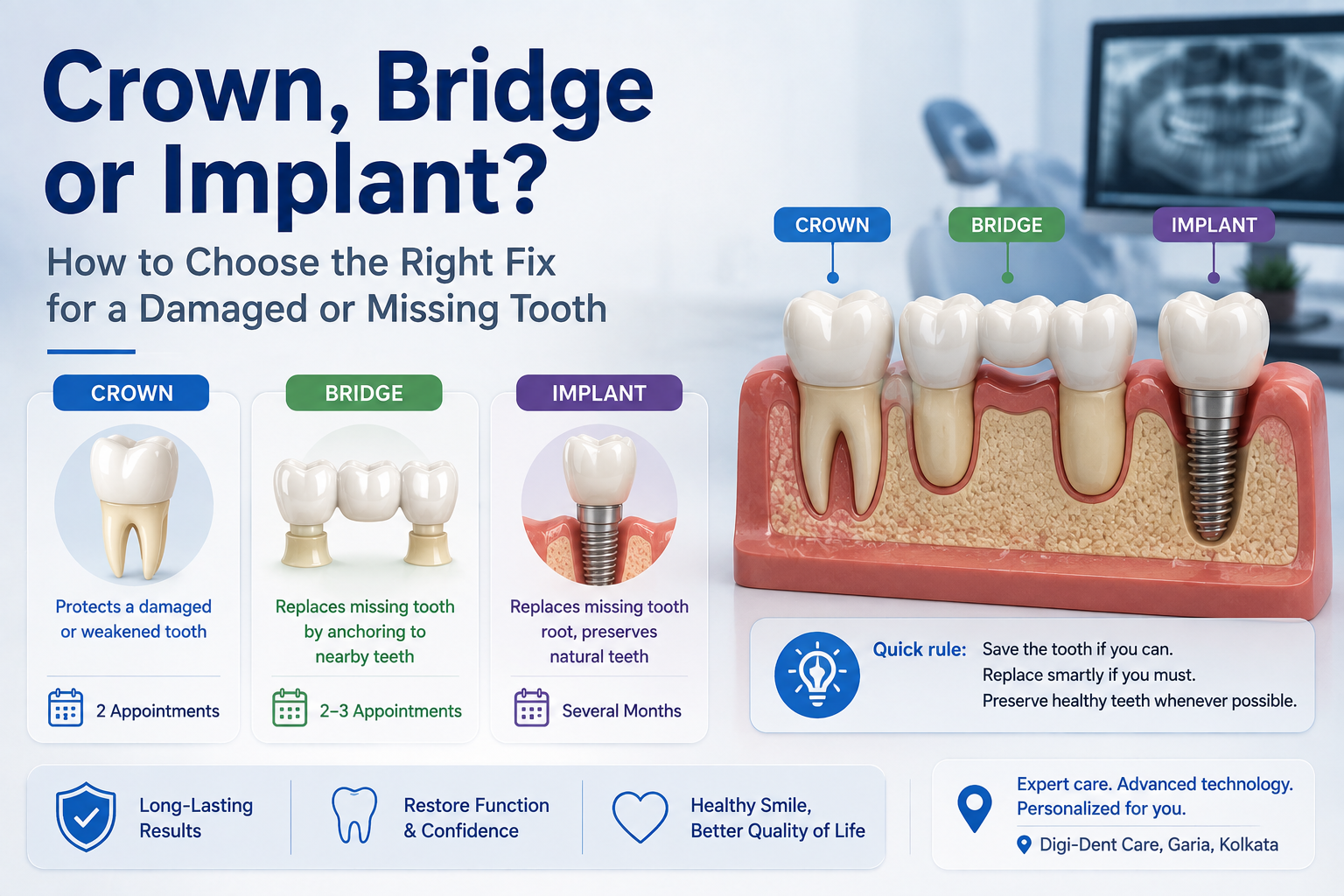
| QUICK ANSWER A crown covers and protects a tooth that is still in your mouth but too damaged for a filling. A bridge replaces a missing tooth by anchoring a false tooth to the teeth on either side of the gap. An implant replaces the missing root itself and leaves the neighbouring teeth untouched. If the teeth beside the gap are already crowned or heavily filled, a bridge is often sensible. If they are healthy and untouched, an implant usually preserves more of your natural tooth. An examination with a digital X-ray and a 3D scan settles which applies to you. |
Crown, bridge or implant — the difference in one minute
These three words get used interchangeably in conversation, but they solve different problems.
| CROWN | BRIDGE | IMPLANT | |
| What it’s for | A tooth that is still present but broken, cracked or heavily filled | A gap where one or more teeth are missing | A gap where one or more teeth are missing |
| Does it touch the neighbouring teeth? | No | Yes — the teeth on both sides are trimmed to hold it | No |
| Does it replace the root? | Not applicable | No — it spans the gap above the gum | Yes |
| Usual timeline | Two appointments, roughly one to two weeks apart | Two to three appointments over a few weeks | Several months, because the bone has to heal around the implant |
| Cleaning | Floss normally | Needs a floss threader or interdental brush underneath, daily | Floss normally |
One more distinction worth holding on to: a crown saves a tooth you still have. A bridge and an implant replace one you have already lost. The cheapest and simplest treatment is almost always the one that keeps the natural tooth in place.
When a tooth needs a crown, not a filling
A filling sits inside a tooth. A crown wraps around it. That difference decides most cases.
A filling works when there is enough healthy tooth left around it to take the chewing force. Once too much of the tooth is gone, a filling becomes a wedge — every bite pushes it outward and the remaining walls of the tooth eventually split. A crown does the opposite. It holds the tooth together from the outside.
The situations where a crown is usually the right call:
- After root canal treatment on a back tooth. The tooth is no longer fed by its nerve and blood supply, it becomes more brittle, and molars take the heaviest load in the mouth.
- When roughly half or more of the biting surface has been lost to decay or fracture.
- When an old, large filling keeps chipping at its edges or the tooth around it is flexing.
- When there is a crack running into the biting surface — a tooth that hurts sharply on release, when you stop biting rather than when you bite down.
- When teeth are severely worn from grinding and have lost their height.
- When the tooth is going to act as an anchor for a bridge.
And the situations where a crown is not needed: a small or moderate cavity, a chipped edge that can be bonded, or a discoloured front tooth where a veneer or whitening would remove far less tooth structure. If a crown is proposed for a tooth that is largely intact, it is entirely reasonable to ask why.
The part that rarely gets said out loud: a bridge costs you two teeth
A conventional three-unit bridge replaces one missing tooth using three connected units — an anchor crown on each side and a false tooth in the middle. To fit those anchor crowns, the two neighbouring teeth are trimmed down all the way around.
If those neighbours are already crowned, heavily filled or root-canal treated, nothing is really lost. They needed covering anyway, and the bridge solves two problems at once. That is a genuinely good use of a bridge.
If those neighbours are healthy, untouched teeth, the calculation changes. You are removing sound enamel from two teeth to replace a third. An implant, where the bone and general health allow it, leaves them alone entirely.
The single most useful question in this whole conversation: “Are the teeth on either side of my gap already restored?” The answer decides bridge versus implant more often than anything else — more than cost, and more than preference.
None of this makes bridges a poor treatment. They are fixed, they are quicker than an implant, they don’t depend on bone volume, and they have restored chewing for millions of people. It simply means the choice deserves a real conversation rather than a default.
What crowns are made of, and why zirconia took over
Crown materials have changed considerably over the last two decades. Here is what exists and where each one fits.
| MATERIAL | STRENGTH | APPEARANCE | TYPICALLY USED FOR |
| Zirconia | Very high | Good, and much improved in layered and multi-shade versions | Back teeth, heavy biters, night grinders, long-span work |
| Metal-free ceramic (all-ceramic) | Good | Best — translucency closest to natural enamel | Front teeth and anywhere appearance is the priority |
| Porcelain fused to metal | High | Reasonable, but a grey line can appear at the gum edge as gums recede over the years | An older workhorse, still used in some cases |
| Full metal | Highest | Visibly metallic | Rear molars where the bite force is greatest and the tooth is not visible |
At Digi-Dent Care, the crowns most commonly planned are zirconia and metal-free ceramic, including implant-supported crowns and fixed bridges. Which one suits your tooth depends on where it sits in the mouth, how hard you bite, how much space there is, and the shade of the teeth on either side.
A practical note on shade: matching a single front crown to natural teeth is the hardest job in restorative dentistry, because a natural tooth is not one flat colour. Shade selection is best done in daylight, early in the appointment, before the teeth dry out and lighten.
What actually happens, visit by visit
For a straightforward crown, the process looks like this.
VISIT 1
Examination, X-ray and plan
The tooth is examined, a chairside digital X-ray shows what is happening at the root and around the bone, and the gum condition is checked. You are told what the tooth needs, what the alternatives are, and what it will cost — in writing, before anything begins. Nothing is prepared on this visit.
VISIT 2
Preparation and 3D scan
The tooth is numbed and shaped so the crown has room to sit without making the tooth bulky. If a lot of tooth is missing, a core build-up is placed first to rebuild the foundation. An intraoral scanner then records the prepared tooth and your bite — a small wand, no impression tray and no putty. Shade is matched, and a temporary crown protects the tooth until the next visit.
BETWEEN VISITS
The crown is made
The digital file is used to design and manufacture the crown. This is the stage where accuracy at the preparation appointment pays off: a well-defined margin and a clean scan produce a crown that seats without the gum being irritated.
VISIT 3
Fit, check and cement
The temporary comes off and the new crown is tried in. Three things are checked before it is cemented: the margin, so nothing catches at the gum; the contact with the neighbouring teeth, tested with floss; and the bite, tested with marking paper. Only when all three are right is it cemented.
AFTERWARDS
A short review
Mild sensitivity for a few days is normal. What is not normal is a bite that feels tall or a tooth that aches when you clench — that means the bite needs a small adjustment, which takes minutes. Call rather than wait it out.
A bridge follows the same sequence, with both anchor teeth prepared at the same appointment and a temporary bridge worn in between.
8 questions worth asking before you agree to a crown or bridge
These are the questions that experienced patients ask. Any dentist should be able to answer all eight without hesitating.
- Why does this tooth need a crown rather than a filling?
- How much of my natural tooth will be removed?
- Does this tooth need root canal treatment first — and if so, what is the reason?
- Which material are you recommending for this particular tooth, and why that one?
- Are the anchor teeth for this bridge already crowned or heavily filled?
- Is my gum condition healthy enough for this to last, or does that need treating first?
- What is the full written cost, including any build-up, and what does it exclude?
- What happens if it chips, loosens or the tooth underneath gives trouble in a few years?
Question six matters more than most patients realise. A crown placed on a tooth with active gum disease is a well-made restoration sitting on an unstable foundation. Gum health is assessed first for exactly this reason.
How long they last — and what actually shortens their life
A commonly quoted range for crowns and bridges is around ten to fifteen years, and many last considerably longer. But the number is far less useful than knowing what shortens it.
| WHAT SHORTENS IT | WHY | WHAT HELPS |
| Night grinding (bruxism) | Repeated overload chips ceramic and fractures margins | A night guard, and zirconia where appropriate |
| Gum disease at the crown margin | The gum recedes, the join is exposed, decay starts underneath | Scaling on schedule and daily cleaning at the margin |
| Not cleaning under a bridge | Plaque collects beneath the false tooth and inflames the gum | A floss threader, superfloss or interdental brush, daily |
| Chewing ice, bones and hard sweets | Point loading cracks even strong ceramic | Avoid — the same advice applies to natural teeth |
| Leaving a loose crown | The seal breaks and the tooth beneath decays out of sight | Get it re-checked within days, not months |
The crown itself never decays. The tooth underneath it can. That single fact explains almost every crown that fails early — the restoration was fine, the margin was not being cleaned, and the decay was invisible until it reached the nerve.
Looking after crowns and bridges
- Brush twice daily, and angle the bristles at the gum line where the crown meets the tooth. This join is the only vulnerable part.
- Floss normally around a crown. Ease the floss out sideways rather than snapping it up, so you don’t tug at the margin.
- Under a bridge, use a floss threader, superfloss or an interdental brush every day. You cannot floss between the units — they are joined — so cleaning goes underneath the false tooth.
- A water flosser is a useful addition under bridgework, but not a replacement for mechanical cleaning.
- Wear a night guard if you grind. It is the cheapest insurance available for expensive restorations.
- Keep to your scaling and check-up schedule so margins and gums are reviewed before anything becomes symptomatic.
Signs an existing crown or bridge needs attention
Restorations rarely fail suddenly. They give notice first.
- A crown that feels slightly loose or moves when you press it with your tongue
- Cold sensitivity in a crowned tooth that was previously comfortable
- A bad taste or odour that returns to the same spot soon after brushing
- The gum bleeding consistently at one margin and nowhere else
- A chipped edge, or a rough patch you keep catching with your tongue
- A bridge that feels as though it rocks very slightly when you chew
Any of these is worth an appointment. A crown that is recemented early is a short visit. A crown left loose for a year often becomes a root canal, or a lost tooth.
What affects the cost of a dental crown and bridge in Garia
There is no single price for a dental crown and bridge in Garia, because a crown on a sound tooth and a crown on a tooth that first needs a root canal, a post and core, and gum treatment are different pieces of work.
What moves the figure: the material chosen, how many units are involved, whether root canal treatment or a core build-up is needed first, whether gum treatment has to come first, and whether the plan is a bridge or an implant. At Digi-Dent Care you receive a written estimate after the examination, before treatment begins — not afterwards. Call +91 89102 28151 for current details.
Not sure which one your tooth needs?
Bring the tooth in and find out properly. A consultation for a dental crown and bridge in Garia includes an examination, a chairside digital X-ray and a 3D scan where it is needed, and you leave with a written plan and the reasoning behind it.
| DIGI-DENT CARE Digitally Advanced Multispeciality Dental Clinic ADDRESS Saptatari, A/41, New Scheme, Goshtotala, Garia, Kolkata – 700084 PHONE +91 89102 28151 EMAIL digidentcare24@gmail.com WEBSITE www.digidentcare.com Serving Garia, Garia Station, Naktala, Patuli, Baghajatin, Bansdroni, Jadavpur, Kamalgazi and Sonarpur. |
Planning a dental crown and bridge in Garia? Book a consultation at our Garia clinic, browse our full range of dental services, or meet the doctors who will be treating you.
Frequently asked questions
1. Is a “cap” the same thing as a crown?
Yes. Cap is the everyday word and crown is the clinical one — they describe the same restoration, a custom-made cover cemented over a prepared tooth. If your dentist says cap and the estimate says crown, nothing different is being proposed.
2. How long do crowns and bridges last?
A commonly quoted range is ten to fifteen years, and plenty last longer than that. Longevity depends far more on gum health, daily cleaning at the margin and whether you grind at night than on the material itself. The restoration usually outlives the tooth’s environment, not the other way round.
3. Does getting a crown hurt?
The preparation is done under local anaesthesia, so you should feel pressure and vibration rather than pain. Mild sensitivity for a few days afterwards is normal while the tooth settles. Pain when you bite down after the crown is fitted usually means the bite is fractionally high and needs a two-minute adjustment — not something to endure.
4. Bridge or implant — which is better?
Neither is better in general; they are better in different situations. If the teeth on either side of the gap are already crowned or heavily filled, a bridge uses them sensibly and is quicker. If those teeth are healthy and your bone volume and general health allow it, an implant avoids cutting them at all. A 3D scan and an X-ray make the answer clear for your specific case.
5. Do I need a root canal before every crown?
No. Root canal treatment is needed only when the nerve is already infected, irreversibly inflamed, or so close to the damage that it cannot be preserved. Many crowns are placed on teeth with perfectly healthy nerves. If root canal treatment is being recommended, ask what the X-ray or the symptoms are showing.
6. Will a crown on a front tooth look obviously fake?
It shouldn’t. Metal-free ceramic and layered zirconia reproduce the translucency of enamel closely, and shade is matched against your neighbouring teeth in daylight before the crown is made. The harder task is a single front crown next to natural teeth, which is why shade matching gets its own time in the appointment rather than being rushed at the end.
7. My crown came off. Can it just be stuck back on?
Often, yes — if the crown is undamaged and the tooth beneath is sound, it can be recemented. Keep the crown, don’t try to fix it yourself with any household adhesive, and book quickly. The exposed tooth is sensitive and unprotected, and decay progresses fast once the seal is gone.
8. How many missing teeth can one bridge replace?
A bridge can span more than one missing tooth, but the limit is set by the anchor teeth rather than the gap. Each anchor has to carry its own chewing load plus a share of the false teeth, so a long span puts those teeth under strain and shortens the life of the whole unit. Where the gap is long, or the anchors are not strong enough, implants or an implant-supported bridge are usually the more durable answer. An X-ray of the roots and the surrounding bone decides it.
9. What can I eat after a crown or bridge is fitted?
Once the permanent restoration is cemented you can eat normally, though it is sensible to stay off very hard and very sticky food for the first day while the cement reaches full strength. The bigger caution is during the temporary stage: temporary crowns are held with weak cement on purpose, so chewing gum, toffee and hard nuts on that side will pull them off. Long term, the things to avoid are the same ones that damage natural teeth — ice, bones, hard sweets and opening packets with your teeth.
10. My gum is sore and bleeding around a new crown. Is that normal?
For the first few days, some tenderness is expected, because the gum has been retracted during preparation and handled during cementation. What is not expected is bleeding, soreness or a bad taste that is still there after a couple of weeks. That usually points to leftover cement at the margin, a crown edge that sits slightly proud, or a contact that is trapping food. All three are fixable, and all three cause damage if left, so have it looked at rather than waiting for it to settle.
11. Can crowns and bridges be whitened, or do they stain?
Ceramic and zirconia do not respond to whitening at all — the shade they are made in is the shade they stay. They also resist staining better than natural enamel, though the cement line at the gum can pick up colour over the years. The practical consequence matters if you are considering whitening: whiten your natural teeth first, let the shade stabilise for a couple of weeks, and only then have the crown made to match. Doing it the other way round leaves a restoration that no longer matches the teeth beside it.
12. What happens if I leave the gap and do nothing?
A gap does not stay a gap. The teeth on either side gradually tilt into the space and the tooth in the opposing jaw drifts down or up because nothing meets it, which changes your bite and creates new food traps and cleaning problems. The jawbone in that area also loses stimulation and slowly reduces in volume, which can limit implant options later. None of this happens quickly, and that is precisely why it gets ignored — but the treatment available in five years is usually more complicated than the one available now.
| WRITTEN AND CLINICALLY REVIEWED AT DIGI-DENT CARE Dr. Sumit Kr. Roy — BDS, MDS (Prosthodontics & Implantology). Prosthodontics is the dental specialty concerned with crowns, bridges, dentures and implant-supported restorations, which is the direct subject of this article. Dr. Roy works in digital and CAD-CAM dentistry and implant prosthodontics, serves as an Associate Professor at a private dental college, and lectures and conducts hands-on training at national conferences. Dr. Surupa Dutta — BDS, MDS (Periodontology & Implantology), with over ten years of clinical experience. Gum health determines how long a crown or bridge survives, which is why periodontal assessment precedes restorative work at this clinic. Reviewed: [insert publication date]. Next review due: [insert date, 12 months later]. |