Best root canal service in Garia — affordable single sitting root canal treatment in Garia, Kolkata, by MDS specialists.
Medically reviewed by Dr. Sumit Kr. Roy, BDS, MDS (Prosthodontics & Implantology) — Associate Professor; specialist in advanced root canal treatment and implant-supported rehabilitation
Co-reviewed by Dr. Surupa Dutta, BDS, MDS (Periodontology & Implantology)
If a tooth is keeping you awake, throbbing when you lie down, or hurting every time you bite, you are probably looking for two things: relief, and a clear answer about what happens next. That is exactly what we set out to give every patient searching for the best root canal service in Garia.
A root canal is the treatment that saves the tooth rather than removing it. At Digi-Dent Care in Garia we provide affordable single sitting root canal treatment using rotary endodontics and digital diagnosis — with a clear explanation of findings and cost before we begin. You can also browse our full range of dental services in Garia.
Phone: +91 89102 28151 · Saptatari, A/41, New Scheme, Goshtotala, Garia, Kolkata – 700084
Why You May Need Root Canal Treatment
Inside every tooth is a soft core called the pulp — nerve, blood vessels and connective tissue. Deep decay, a crack, trauma, or a leaking old filling lets bacteria reach it. Once infected, the pulp cannot heal on its own, because it is sealed inside a hard chamber with no way to drain.
The infection travels down the root canals and out through the root tip into the surrounding bone.
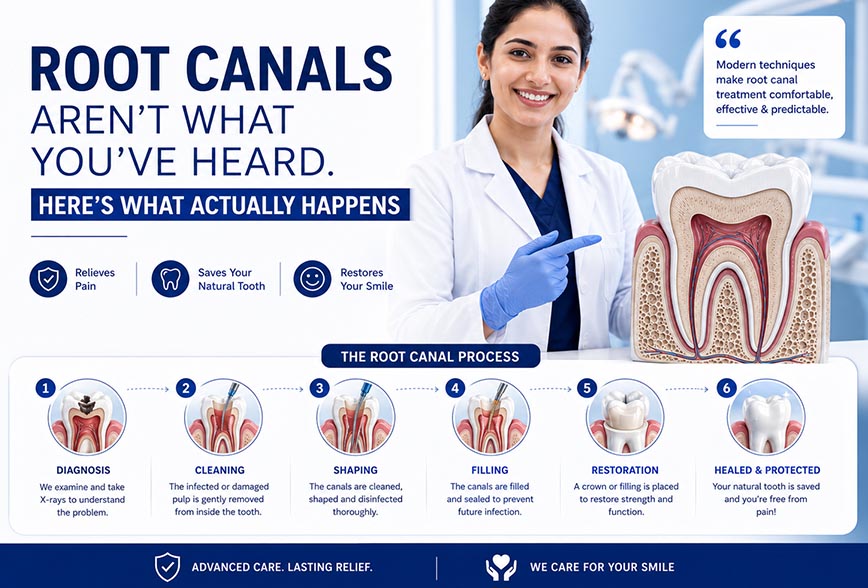
Root canal treatment removes the infected pulp, disinfects and shapes the canals, and seals them so bacteria cannot return. The tooth is then rebuilt, usually with a crown. This is the same sequence described by the American Association of Endodontists and by the NHS.
Why saving the tooth is worth it
- Your own tooth root maintains the jawbone. Once a tooth is removed, bone at that site gradually resorbs.
- Neighbouring teeth stay put. Teeth beside a gap drift and tilt over time, disturbing the bite.
- Nothing chews like a natural tooth. An implant is an excellent replacement, but it is a replacement.
- It is the more affordable option long-term. Extraction costs less on the day; extraction followed by an implant or bridge does not.
What happens if it is left alone
Untreated pulp infection leads to an abscess, bone loss around the root, spread to nearby tissue, and eventually a tooth that cannot be saved.
One warning worth taking seriously: when the pain stops on its own, that is often not recovery. Once the nerve dies, the ache fades while the infection continues into the bone. Many patients arrive with swelling months after the tooth “got better.”
When You Need a Root Canal
Come in for an examination if you have:
- Persistent toothache — throbbing, deep, or waking you at night
- Sensitivity that lingers — pain continuing 30 seconds or more after hot or cold is removed
- Pain on biting or chewing on one specific tooth
- Swollen, tender gum localised around one tooth
- A pimple-like bump on the gum, sometimes draining pus or leaving a bad taste
- A tooth that has darkened compared to its neighbours
- A cracked or broken tooth, even if it does not hurt yet
- Deep decay — a visible hole, dark staining, or food trapping in the same spot
Come in the same day if you have
- Severe pain not relieved by painkillers
- Swelling of the face or under the jaw
- Fever alongside tooth pain
- Pus discharge
- Difficulty swallowing, breathing or opening your mouth — treat this as a medical emergency
Antibiotics may settle swelling temporarily, but they cannot sterilise dead pulp inside a canal. The source has to be treated.
Not every toothache is a root canal
Sensitivity from exposed roots, a shallow cavity, gum inflammation, a cracked filling, or grinding can all mimic pulp pain and are treated far more simply — and far more cheaply. Only an examination with an X-ray can tell the difference, which is why we diagnose before quoting.
How Root Canal Treatment Works at Digi-Dent Care
1. Diagnosis before anything else
Clinical examination, chairside digital X-ray, and pulp vitality and bite testing to confirm which tooth is the source and how far the infection has travelled. Digital radiography gives an immediate image at markedly lower radiation than conventional film.
You are shown the findings and given the treatment plan and cost before treatment starts.
2. Local anaesthesia
The tooth and surrounding tissue are fully numbed. You should feel pressure and vibration during the procedure, not pain.
3. Isolation
A rubber dam keeps the tooth dry and free from saliva. This is not optional detail — it is one of the factors most closely linked to long-term success.
4. Cleaning and shaping with rotary endodontics
The infected pulp is removed and the canals shaped using rotary instruments driven by an endomotor, which are faster and more consistent than hand filing. An apex locator establishes the exact working length so the canal is cleaned to the root tip and no further.
5. Disinfection
Canals are irrigated with antibacterial solution to reach the microscopic branches no instrument can enter.
6. Sealing
The canals are filled with a biocompatible material and sealed against reinfection.
7. Rebuilding the tooth
A post and core build-up where significant structure has been lost, followed by a crown — zirconia, metal-free ceramic, or implant-supported as appropriate.
Single sitting root canal treatment
Most uncomplicated cases are completed in one appointment of roughly 45 to 90 minutes. For suitable teeth, single-visit treatment has comparable long-term success to multi-visit treatment, with no temporary dressing to lose in between — and fewer appointments to take time off for.
Some teeth are better done over two visits — heavy infection with active drainage, unusually curved or calcified canals, or retreatment cases. If yours is one of them, we tell you at the diagnosis stage, not halfway through.
Re-root canal treatment (endodontic retreatment)
If a tooth treated elsewhere has not settled, or symptoms have returned years later, the original filling material can be removed, the canal system re-cleaned, and the tooth resealed. Retreatment is technically demanding and takes longer than a first-time root canal — but it often saves a tooth that has otherwise been written off, at a fraction of the cost of replacing it.
Why the crown matters
A root canal treated tooth has lost internal structure and becomes brittle, particularly molars and premolars carrying heavy chewing force. Skipping the crown to save money is the most common reason a successful root canal fails later — and a vertically fractured root usually cannot be saved at all.
You can chew on an uncrowned treated tooth. You are simply gambling on when it cracks — and a cracked tooth costs far more to replace than a crown costs to fit.
Root Canal vs Extraction
| Root canal | Extraction | |
| Keeps your natural tooth | Yes | No |
| Relieves pain and infection | Yes | Yes |
| Jawbone | Maintained | Gradually resorbs |
| Neighbouring teeth | Stay stable | May drift or tilt |
| Cost on the day | Moderate | Lower |
| Cost long-term | More affordable overall | Implant or bridge adds significantly |
Extraction is the right decision for a vertically fractured root, severe bone loss, or a tooth too broken down to restore. Where the tooth can be saved, saving it is almost always the better and more affordable choice.
What Affects the Cost of Your Root Canal
Every tooth is different, so a single advertised figure rarely reflects what you will actually pay. The best root canal service in Garia will always quote after diagnosis, never before it. What matters is:
- Which tooth it is. Anterior teeth generally have one canal; molars often have three or four, and each one has to be cleaned, shaped and sealed.
- How far the infection has spread, and whether the tooth needs settling before sealing.
- Whether it is a first treatment or a retreatment. Retreatment takes longer and is more demanding.
- Whether a post and core build-up is needed to rebuild lost structure.
- Which crown you choose — zirconia and metal-free ceramic differ in price.
How we handle it: you are examined and X-rayed first, then given an exact figure for your tooth — including whether a crown is needed and what it will cost — before any treatment begins. The price does not change mid-treatment.
For an affordable root canal treatment quote specific to your tooth, call +91 89102 28151.
Why Choose Digi-Dent Care for the Best Root Canal Service in Garia
MDS specialists, not a rotating panel. Your treatment is performed by Dr. Sumit Kr. Roy (MDS, Prosthodontics & Implantology) or Dr. Surupa Dutta (MDS, Periodontology & Implantology). Dr. Roy is an Associate Professor at a private dental college, leads one of Eastern India’s advanced CAD-CAM digital dental centres, and delivers hands-on training in digital dentistry at national conferences.
Digitally advanced diagnosis. Chairside digital X-rays for immediate imaging at reduced radiation, and intraoral scanning that eliminates conventional impression trays when your crown is made — no putty, no gagging.
Rotary endodontics as standard, with single sitting treatment wherever the tooth allows.
Root canal and crown under one roof. Endodontics, post and core, and CAD-CAM zirconia and ceramic crowns are all handled in-house by the same team. No coordinating between clinics for the restoration that protects your treated tooth — and no separate lab mark-ups stacking onto your bill.
Strict sterilisation. All instruments sterilised through advanced autoclave systems, with high-quality disposables used wherever appropriate.
Affordable, transparent and fixed. Diagnosis first, then a clear figure for your specific tooth. No surprises, and no revision partway through treatment.
Honest about what your tooth needs. If a second visit is the better clinical decision, we say so. If a tooth genuinely cannot be saved, we tell you that too rather than treating it and hoping — because unnecessary treatment is the most expensive treatment there is.
Aftercare
- Mild tenderness for two to four days is normal and settles with routine painkillers
- Avoid chewing on the treated side until the permanent crown is fitted
- Do not eat or drink until the anaesthetic has fully worn off, to avoid biting your cheek or tongue
- Complete any prescribed medication as directed
- Brush and floss normally, with care around the treated tooth
- Return for the crown appointment. A temporary filling is not a long-term seal
- Attend routine check-ups so recurrent decay under a crown is caught early
Book Your Root Canal Consultation
Get a proper diagnosis, a digital X-ray, and a clear, affordable quote for your tooth. If you have been searching for the best root canal service in Garia, book an appointment at our Garia clinic or call us directly.
Phone: +91 89102 28151
Email: digidentcare24@gmail.com
Address: Saptatari, A/41, New Scheme, Goshtotala, Garia, Kolkata – 700084
Book online: www.digidentcare.com/contact-us/
Frequently Asked Questions
1. Is a root canal painful?
The procedure itself should not be painful — the tooth is fully anaesthetised and most patients say it felt like having a deep filling. The pain people associate with root canals is almost always the infection before treatment. Mild soreness for two to four days afterwards is normal.
2. How long does a root canal take?
Most uncomplicated cases are completed in one sitting of 45 to 90 minutes. Molars with several canals, heavily infected teeth, and retreatment cases take longer or may need a second visit. The crown is fitted at a separate appointment.
3. Can it be done in a single visit?
For suitable teeth, yes — with comparable long-term success to multi-visit treatment and no temporary dressing in between. Teeth with active drainage or difficult canal anatomy are often better treated over two appointments, and we tell you which applies to your tooth at diagnosis.
4. Is affordable root canal treatment available in Kolkata?
Yes, and cost varies mainly with the tooth — number of canals, extent of infection, whether retreatment is needed, and the crown chosen. Rather than quoting a headline figure that may not apply to you, we examine and X-ray the tooth first and then give you an exact price before treatment begins.
5. Do I really need a crown afterwards?
For back teeth, almost always. The treated tooth is more brittle and a crown distributes chewing force and protects against fracture. Some front teeth can be restored with a filling instead. Skipping a recommended crown is the most common reason a successful root canal fails later — and replacing a fractured tooth costs considerably more.
6. My tooth stopped hurting — can I skip treatment?
No. Pain usually disappears because the nerve has died, not because the infection has resolved. Such teeth typically stay quiet for weeks or months before flaring up as swelling or an abscess. Get it assessed even if it currently feels fine.
7. Can antibiotics treat it instead?
No. Antibiotics can temporarily reduce swelling and control spreading infection, but they cannot clean out dead tissue inside a canal. Symptoms return once the course ends. Antibiotics support treatment; they do not replace it.
8. How long does a treated tooth last?
With proper sealing, a well-fitted crown and good hygiene, a root canal treated tooth can last decades and often a lifetime. Regular check-ups catch problems such as decay under the crown early.
9. What if a previous root canal has failed?
Retreatment is often possible. The original filling material is removed, the canal system re-cleaned and disinfected, and the tooth resealed. It is more demanding than a first treatment but frequently saves a tooth that would otherwise be extracted and replaced at far greater cost.
10. Is a root canal safe during pregnancy?
Yes, and treating active infection is generally safer than leaving it. The second trimester is usually most comfortable. Tell us you are pregnant so shielding, medication and positioning can be adjusted.
11. Does insurance cover root canal treatment?
Many dental policies cover the root canal itself, while crowns are sometimes classified as cosmetic and excluded. Check the specifics with your insurer, as coverage varies by policy.
12. What if my tooth cannot be saved?
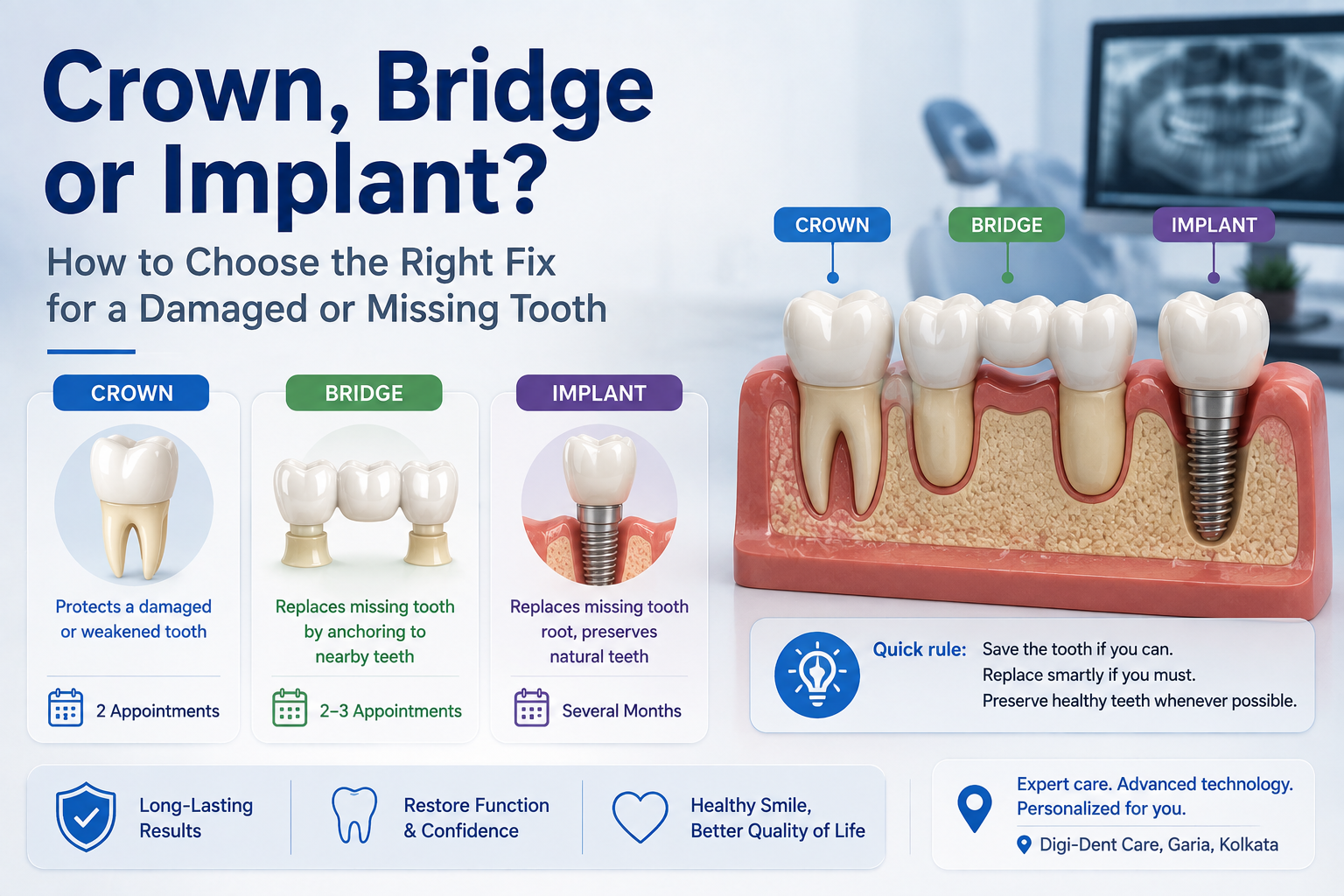
We will tell you plainly rather than attempting treatment unlikely to succeed. Where extraction is unavoidable, we plan the replacement — single tooth implant, implant-supported crown, or bridge — as part of the same conversation, often using computer-assisted implant surgery for accurate placement.
This page is for general information and patient education. It is not a substitute for an in-person examination, diagnosis or treatment plan. Costs and treatment approach vary with individual clinical circumstances. Reviewed by the clinical team at Digi-Dent Care, Garia, Kolkata.