Medically reviewed by Dr. Sumit Kr. Roy, BDS, MDS (Prosthodontics & Implantology) — Associate Professor and Implantologist, Digi-Dent Care, Garia, Kolkata
Co-reviewed by Dr. Surupa Dutta, BDS, MDS (Periodontology & Implantology) — 10+ years of clinical experience
If you have been searching for the best root canal treatment in Garia, there is usually a tooth behind that search — one that has been aching, throbbing at night, or quietly changing colour for weeks. This guide covers the 10 warning signs that a tooth may need root canal treatment, how dentists confirm the diagnosis, what the procedure actually involves, and the point at which a toothache stops being something you can wait out.
Most people don’t walk into a dental clinic the day a tooth starts hurting. They wait. They rinse with salt water, chew on the other side, take a painkiller, and hope it settles down on its own.
Sometimes it does settle — for a while. But in our clinic in Garia, a large share of the emergency cases we see each month began exactly this way: a dull ache that was ignored for weeks, until it turned into swelling, a sleepless night, or a tooth that could no longer be saved.
The frustrating part is that the tooth was usually salvageable early on. A root canal treatment (RCT) at the right time saves the natural tooth. The same tooth, left alone for another three months, often ends up needing extraction and then an implant or bridge — more time, more cost, more discomfort.
This guide explains what a root canal actually is, the ten signs that suggest you may need one, and when tooth pain becomes a genuine emergency.
What Is a Root Canal Treatment?
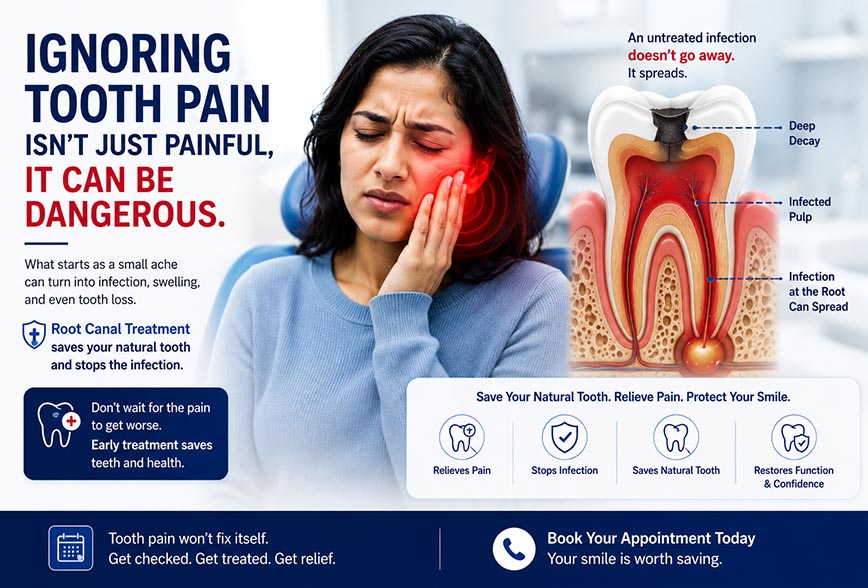
Inside every tooth, beneath the hard enamel and dentine, is a soft core called the pulp. It contains the nerve, blood vessels, and connective tissue that kept the tooth alive as it developed.
When deep decay, a crack, repeated dental work, or trauma allows bacteria to reach that pulp, it becomes inflamed and eventually infected. Because the pulp is sealed inside a hard chamber, the infection cannot drain or heal by itself. It travels down the root canals and out through the root tip into the surrounding bone.
Root canal treatment removes that infected or dead pulp, disinfects and shapes the canal system, and seals it so bacteria cannot return. The tooth is then restored — usually with a crown — so it can bite and chew normally again.
Two things worth clearing up straight away:
- A root canal is not the cause of pain. It is the treatment that ends it.
- It is not a “last resort” in the sense of being a failure. It is the procedure that lets you keep a tooth that would otherwise have to be removed.
At Digi-Dent Care we perform single sitting root canal treatment and rotary endodontics, along with re-root canal treatment (endodontic retreatment) for teeth that were treated elsewhere and did not heal.
Why Ignoring a Toothache Is a Bad Bet
A pulp infection does not stay in one place. Left untreated, it can lead to:
- A dental abscess — a pocket of pus at the root tip
- Bone loss around the root, which weakens support for the tooth
- Spread to neighbouring teeth and the surrounding soft tissue
- Facial space infections — swelling that tracks into the cheek, floor of the mouth, or neck. This is uncommon, but it is a medical emergency when it happens
- Loss of the tooth, followed by drifting and tilting of adjacent teeth
- Higher overall cost, because replacing a tooth costs considerably more than saving one
There is one more trap worth knowing about: pain that disappears on its own is not always good news. When the pulp finally dies, the nerve stops signalling and the ache fades. The infection is still there, quietly working its way into the bone. Patients often tell us the tooth “got better” two months before the swelling started.
10 Signs You May Need a Root Canal Treatment
1. Persistent, spontaneous toothache
Pain that keeps returning — throbbing, deep, sometimes hard to point to — is the most common reason patients end up needing endodontic treatment. Pulpal pain often radiates, so the ache may seem to come from the jaw, ear, or a nearby tooth. If discomfort persists beyond a few days or wakes you at night, get it examined.
2. Sensitivity to hot and cold that lingers
A quick zing from cold water or hot tea that vanishes in a second or two is usually ordinary sensitivity or a small area of exposed dentine.
The concerning pattern is different: the tooth reacts, and the pain stays for 30 seconds, a minute, or longer after the hot or cold is gone. Lingering sensitivity — particularly to heat — is a classic sign of irreversible pulpitis, meaning the pulp is inflamed beyond recovery.
3. Pain when biting or chewing
If one specific tooth hurts sharply the moment you bite down, or aches when you press it, the infection has likely extended past the root tip into the ligament that holds the tooth in place. The tooth may also feel slightly “high” or raised compared to the others.
4. Swollen, tender gums near one tooth
Localised swelling, redness, or tenderness in the gum next to a single painful tooth is a strong indicator. Unlike gum disease, which affects the tissue broadly, this stays focused around one root.
5. A pimple-like bump on the gum
A small bump that appears near the root — sometimes releasing pus, sometimes leaving a salty or foul taste — is called a sinus tract. It is the body’s drainage route for an abscess.
Because it drains, the pain may be mild or absent entirely. Do not read that as improvement. A sinus tract means an active, established infection.
6. A tooth that has changed colour
A single tooth turning grey, brown, or darker than its neighbours often means the pulp inside has died, frequently years after an old injury. Discolouration in one tooth without any obvious staining elsewhere always deserves a check-up.
7. Sensitivity or pain with no obvious trigger
Pain that arrives on its own — while you are sitting still, or lying down at night — is more significant than pain you can provoke. Symptoms often worsen when lying flat because of increased blood flow to the head, which is why so many patients call us the morning after a bad night.
8. A cracked, chipped, or fractured tooth
A crack gives bacteria a direct path to the pulp even when there is no visible cavity. Sometimes the tooth stays comfortable for months before the infection develops. A tooth that is intermittently sensitive to biting pressure, with no decay visible, is often a cracked tooth.
9. Deep decay or a large existing cavity
A cavity that has reached the pulp cannot be fixed with a filling alone. Warning signs include a visible hole, dark brown or black areas on the tooth, food packing into the same spot repeatedly, or a broken-down filling. Deep decay on an X-ray sitting close to the pulp chamber is one of the most reliable early indicators.
10. Jaw pain, facial swelling, or difficulty opening the mouth
These suggest the infection has spread beyond the tooth. Swelling of the face, difficulty opening the jaw, pain radiating to the ear or neck, fever, or feeling generally unwell all require same-day dental care — not a wait-and-see approach.
How Do Dentists Actually Confirm You Need a Root Canal?
Symptoms point in a direction; they do not make the diagnosis. Two teeth with identical pain can need completely different treatment. A proper assessment involves:
- A clinical examination — checking for decay, cracks, existing restorations, swelling, and gum condition
- Digital X-rays (IOPA) — showing how close decay is to the pulp and whether infection has caused bone loss at the root tip. Chairside digital radiography gives an immediate image with markedly lower radiation than conventional film
- Pulp vitality testing — cold or electric pulp tests to determine whether the nerve is healthy, inflamed, or dead
- Percussion and bite tests — identifying which tooth is truly the source
- 3D imaging (CBCT) where required — for complex root anatomy, retreatment cases, or suspected fractures
This is also why self-diagnosis from the internet is unreliable. Sinus infections, wisdom teeth, gum disease, a cracked filling, and grinding can all mimic pulpal pain. The purpose of this article is to tell you when to get checked, not to replace the check-up.
What Happens During a Root Canal at Digi-Dent Care
The modern procedure is closer to having a deep filling done than to the reputation it carries.
- Diagnosis and planning — digital X-ray, vitality testing, and a clear explanation of findings and cost before anything begins
- Local anaesthesia — the tooth and surrounding tissue are fully numbed
- Isolation — a rubber dam keeps the tooth clean, dry, and free from saliva
- Access and cleaning — the infected pulp is removed and the canals shaped using rotary endodontic instruments, which are faster and more precise than hand filing
- Disinfection — canals are irrigated with antibacterial solutions to clear the microscopic branches instruments cannot reach
- Sealing — the canals are filled with a biocompatible material and sealed
- Restoration — a post and core build-up where needed, followed by a crown
How long does it take? Many uncomplicated cases are completed in a single sitting of 45–90 minutes. Teeth with severe infection, curved or calcified canals, or retreatment cases may need two visits.
Does it hurt? During the procedure you should feel pressure and vibration but not pain. Mild tenderness for two to four days afterwards is normal and usually manageable with routine painkillers.
The crown matters. A back tooth that has had a root canal is more brittle and is at real risk of fracturing without proper coverage. Skipping the crown to save money is the single most common reason a successfully treated tooth is later lost.
Root Canal vs Extraction: Which Is Better?
| Factor | Root Canal Treatment | Extraction |
| Keeps your natural tooth | Yes | No |
| Relieves pain and infection | Yes | Yes |
| Preserves natural bite and chewing | Yes | Requires replacement |
| Effect on jawbone | Bone is maintained | Bone gradually resorbs at the site |
| Neighbouring teeth | Remain stable | May drift or tilt into the gap |
| Immediate cost | Moderate | Lower |
| Long-term cost | Usually lower overall | Implant or bridge adds significantly |
| Typical timeline | 1–2 visits plus a crown | Extraction, healing, then replacement |
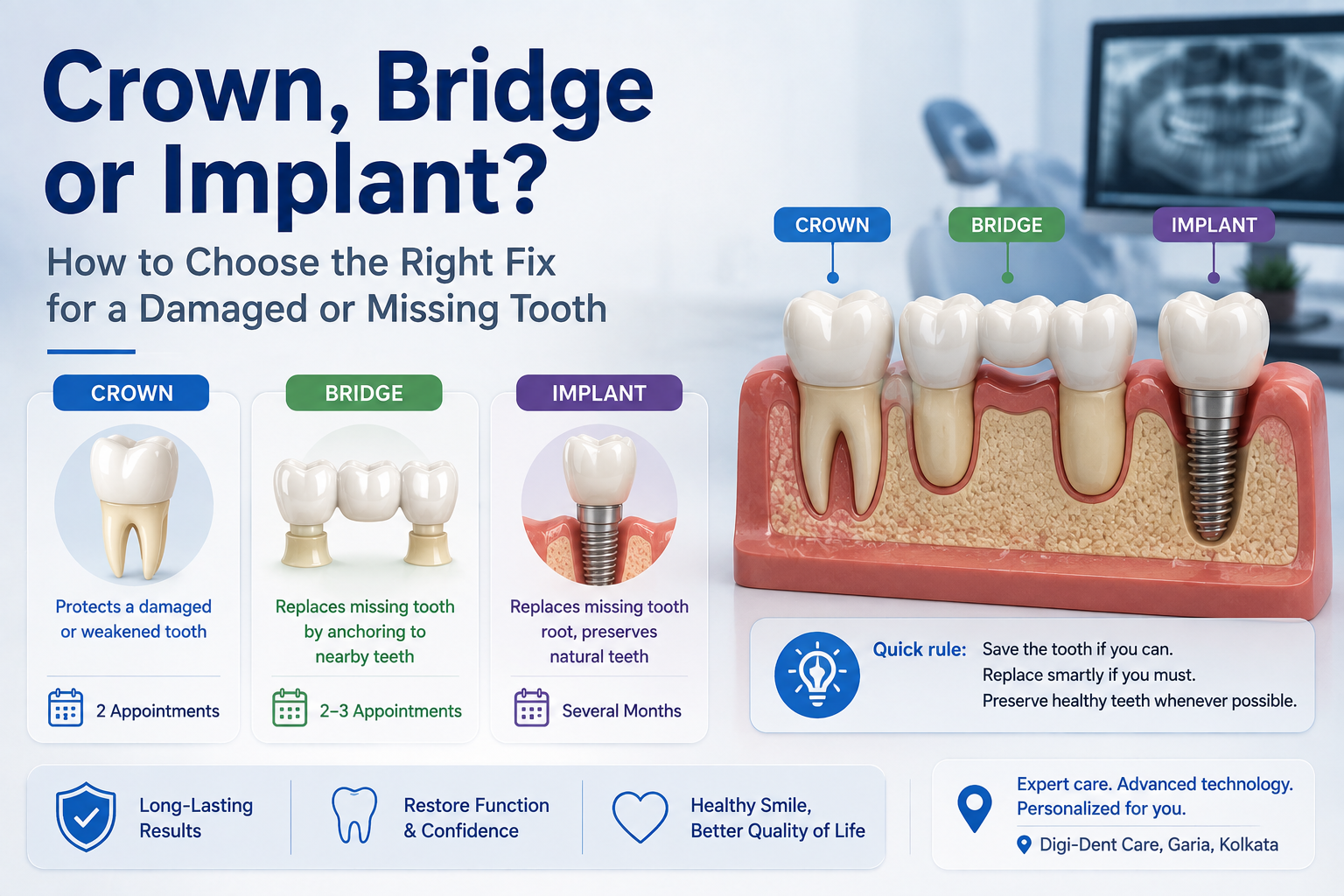
Extraction is the right call in some situations — a vertically fractured root, extremely severe bone loss, or a tooth too broken down to restore. But when the tooth can be saved, saving it is almost always the better long-term decision. No artificial replacement functions quite like a natural tooth root.
When to See a Dentist Immediately
Book a same-day appointment, or go to a hospital if a clinic is unavailable, if you have:
- Severe pain not controlled by over-the-counter painkillers
- Swelling of the face, cheek, or under the jaw
- Fever alongside tooth pain
- Pus discharge or a foul taste from around a tooth
- Difficulty swallowing, breathing, or opening your mouth — treat this as a medical emergency
- Pain severe enough to prevent sleep or eating
Painkillers mask the symptom. Antibiotics alone may reduce swelling temporarily but cannot sterilise a dead pulp — the source has to be treated.
How to Choose the Best Root Canal Treatment in Garia
Not every clinic approaches endodontics the same way, and the difference usually shows up years later rather than on the day of treatment. If you are comparing your options for the best root canal treatment in Garia, these are the things worth asking about before you sit in the chair.
- Diagnosis before treatment — a digital X-ray and pulp vitality testing, not a decision made on symptoms alone
- Rubber dam isolation — this keeps saliva and bacteria out of the canal during treatment, and it is one of the clearest markers of careful endodontic work
- Rotary instrumentation — flexible nickel-titanium files shape curved canals more predictably, and usually more comfortably, than hand files alone
- A plan for the crown — a root-treated back tooth generally needs a crown to survive normal chewing forces; ask whether it is part of the quote
- Costs in writing, up front — you should know the full figure, crown included, before anything begins
Digi-Dent Care is a digitally advanced multispeciality clinic in Garia offering single-sitting root canal treatment, rotary endodontics, endodontic retreatment, post and core build-up, and crowns, using intraoral scanning and chairside digital X-rays. If you would like more detail before deciding, you can read what a root canal at our clinic actually involves, browse our full range of dental services in Garia, or read about the clinical team treating you.
And if you would rather have the tooth looked at than read about it, book a consultation at our Garia clinic. A single visit with an X-ray will tell you far more than any article can — including whether root canal treatment in Garia is what you need at all.
Don’t Wait for the Pain to Get Worse
Nearly every tooth we cannot save arrives with the same story: it hurt for a while, then it stopped, and it seemed fine until it wasn’t. The window in which a tooth can be saved is often wide — but it does close.
If you have had a toothache for more than a few days, lingering sensitivity, a bump on your gum, or a tooth that has changed colour, get it examined. A consultation and an X-ray take very little time and give you a definite answer instead of a guess. It is also the quickest way to find out whether what you need is the best root canal treatment in Garia, or something far simpler.
Digi-Dent Care — Digitally Advanced Multispeciality Dental Clinic, Garia
Single sitting root canal treatment, rotary endodontics, endodontic retreatment, post & core build-up, and crowns — using intraoral scanning and chairside digital X-rays.
Address: Saptatari, A/41, New Scheme, Goshtotala, Garia, Kolkata – 700084
Phone: +91 89102 28151
Email: digidentcare24@gmail.com
Book a consultation: www.digidentcare.com/contact-us/
Frequently Asked Questions
1. Does tooth pain always mean I need a root canal?
No. Many toothaches come from a shallow cavity, gum inflammation, exposed roots, a cracked filling, or clenching and grinding, and these are treated far more simply. A root canal becomes necessary only when the pulp itself is irreversibly inflamed or infected. Pain that lingers, keeps returning, or wakes you at night makes pulp involvement more likely, but only an examination with an X-ray can confirm it.
2. Is a root canal painful?
The procedure itself should not be painful. The tooth is fully anaesthetised, and most patients say it felt similar to having a deep filling. The pain people associate with root canals is almost always the pain of the infection before treatment. Mild soreness for a few days afterwards is normal and settles with standard painkillers.
3. How many sittings does a root canal need?
Many straightforward cases are completed in one sitting of about 45–90 minutes. Teeth with active abscesses, unusually curved or narrow canals, or those needing retreatment are often better done over two visits. The crown is usually fitted at a separate appointment.
4. Can a root canal be done in a single sitting? Is it as good as multiple visits?
Yes. For suitable cases, single sitting root canal treatment has comparable long-term success to multi-visit treatment, with fewer appointments and no temporary dressing to lose between visits. Your dentist will advise which approach suits your specific tooth after examining it.
5. What happens if I delay root canal treatment?
The infection continues to spread into the bone around the root. Likely consequences include an abscess, bone loss, worsening pain, spread to nearby tissue, and eventually a tooth that cannot be saved. Delay also frequently turns a straightforward one-visit case into a more complex and expensive one.
6. My tooth stopped hurting. Do I still need treatment?
Very likely, yes. Pain often disappears once the nerve dies — the infection does not disappear with it. Teeth in this state usually stay silent for weeks or months before flaring up as swelling or an abscess. Get it assessed even if it currently feels fine.
7. Why do I need a crown after a root canal?
A treated tooth has lost internal structure and is more brittle, especially molars and premolars that take heavy chewing force. A crown distributes that force and protects against fracture — and a vertically fractured root usually cannot be saved. Skipping the crown is the most common reason a successful root canal fails later.
8. Can antibiotics cure a tooth infection instead?
No. Antibiotics can reduce swelling and control spreading infection temporarily, but they cannot reach or clean out dead pulp tissue inside the canal. Without removing the source, symptoms return once the course finishes. Antibiotics are a support to treatment, not a substitute for it.
9. How long does a root canal treated tooth last?
With proper sealing, a well-fitted crown, and good oral hygiene, a root canal treated tooth can last for decades — often for life. Regular check-ups help catch problems such as recurrent decay under the crown early.
10. What can I eat after a root canal?
Avoid chewing on the treated side until the permanent crown is placed, especially if a temporary filling is in place. Stick to softer foods for the first day or two and avoid very hard or sticky items. Once the crown is fitted, you can eat normally.
11. Is a root canal safe during pregnancy?
It can be performed safely, and treating an active infection is generally safer than leaving it. The second trimester is usually the most comfortable time. Always tell your dentist you are pregnant so shielding, medication, and positioning can be adjusted.
12. Is a root canal treated tooth still worth keeping compared to an implant?
In most cases, yes. A natural tooth preserves the bone and the ligament that cushions your bite, and it is usually less expensive overall than extraction followed by an implant. Implants are excellent when a tooth genuinely cannot be saved — but they are a replacement, not an upgrade.
This article is intended for general information and patient education. It is not a substitute for an in-person dental examination, diagnosis, or treatment plan. If you are experiencing tooth pain, swelling, or fever, please consult a qualified dentist. Content reviewed by the clinical team at Digi-Dent Care, Garia, Kolkata.References and further reading: American Association of Endodontists — patient information on endodontic treatment; NHS UK — Root canal treatment; Indian Dental Association — oral health resources; Cochrane review evidence on single-visit versus multiple-visit endodontic treatment.