How digital treatment simulation lets you try the result before you commit
By Dr. Sumit Kr. Roy, BDS, MDS (Prosthodontics & Implantology) — Associate Professor; leads one of Eastern India’s advanced CAD-CAM digital dental centres
Clinical review by Dr. Surupa Dutta, BDS, MDS (Periodontology & Implantology)
If you are looking for the best smile designing service in Garia, this article explains exactly how we do it — and why you should be able to see, and physically wear, your new smile before you agree to any treatment.
The Patient Who Said No Three Times
She first came to me about four years ago. Her two upper front teeth were chipped and worn at the edges, one was slightly rotated, and there was a dark triangle of shadow between them where the gum had receded. She disliked it enough that she had trained herself to smile with her lips closed — I noticed it within the first minute of the consultation.
I explained the options. She listened carefully, thanked me, and did not book.
She came back a year later. Same conversation, same outcome.
The third time, I stopped explaining and asked her directly what was holding her back.
Her answer was the one I have now heard dozens of times, in slightly different words each time: “I’ve seen people whose teeth look done. Too white, too big, all the same. I would rather keep my crooked teeth than end up looking like that. And once you’ve filed my teeth down, there’s no going back — is there?”
She was not being difficult. She was being entirely rational. She was being asked to consent, permanently, to a result she could only imagine.
So instead of talking, I took a set of photographs, scanned her teeth with an intraoral scanner, and told her to come back in a few days.
When she returned, I showed her two images side by side on the screen: her smile now, and her smile as it would look after treatment. She could see the proportions, the edge positions, how much of the tooth would show when she spoke, where the dark triangle would close.
She looked at it for a long time. Then she asked the question I was hoping for: “Can you make the front two slightly less even? They look a bit too perfect.”
That was the moment the treatment actually began — because for the first time, she was designing it with me instead of surrendering to it.
We adjusted the simulation. Then, before any tooth was prepared, we tried a physical version in her mouth for twenty minutes so she could see it in three dimensions, in her own mirror, in daylight.
She approved it, and we proceeded.
What Digital Treatment Simulation Actually Is
In plain terms: it is a preview of your result, generated before treatment begins.
We take standardised photographs of your face and smile, a 3D scan of your teeth, and often a short video of you talking and smiling naturally. Software combines these into a digital model of your smile as it exists now.
We then design the proposed result on top of that model — new tooth shapes, edge positions, proportions, alignment, gum line — and show you both versions side by side.
Two things patients often assume, both incorrect:
It is not a filter. This is not an app that whitens a photo. The design is built on measured 3D data of your actual teeth, constrained by the bone, gum and bite you actually have. If a tooth cannot physically be moved to a certain position, the simulation will not pretend otherwise.
It is not just for celebrities or extreme makeovers. It is just as useful for a single front crown as for a full smile makeover — arguably more so, because matching one new tooth to the natural teeth beside it is one of the hardest things we do.
Where the AI Part Comes In
“AI” gets used loosely in dental marketing, so let me be specific about what it does here and what it does not.
What the software genuinely helps with:
- Detecting and outlining your teeth and gum line automatically from photographs and scans, instead of a technician tracing every edge by hand
- Measuring proportion and symmetry against your facial midline, lip line, and the curve of your lower lip when you smile
- Suggesting a starting design based on established aesthetic proportions and large libraries of tooth shapes — a first draft, produced in minutes rather than hours
- Simulating how the result behaves in motion — how much tooth shows when you speak, not just when you pose
What it does not do:
It does not decide your treatment. It does not know that you dislike very white teeth, that you are a musician who plays a wind instrument, that you grind at night, or that your gum tissue is thin and will recede if pushed. It has never met you.
The software produces a mathematically pleasing starting point. The clinician then adjusts it against biology, function and — most importantly — what you actually want your face to look like. In my experience the first automated draft is almost always too symmetrical, too uniform. Real teeth are not identical twins. Part of my job is deliberately reintroducing the small irregularities that make a smile look like it grew there rather than like it was installed.
From Screen to Mouth: The Trial Smile
This is the step I insist on, and the one that turns a picture into a decision.
Once the digital design is approved, we can produce a physical mock-up — a thin layer of temporary tooth-coloured material applied over your existing teeth, shaped exactly to the approved design. No drilling. No anaesthetic. Nothing removed.
You wear it for a short while in the chair. You look at it in a mirror, in different light. You speak, smile, and see how it feels against your lip. In some cases we let patients take photographs and think about it.
Then it lifts off, and your teeth are exactly as they were.
The value of this step is difficult to overstate. A screen image is two-dimensional and flattering. A mock-up is in your mouth, on your face, in real light. Patients frequently ask for changes at this stage that they could not have anticipated from the screen — usually about length, and usually asking for slightly less.
It is far better to discover that on a temporary mock-up than on a finished set of ceramics.
Why This Matters More Than It Sounds
It converts an irreversible decision into a reversible one
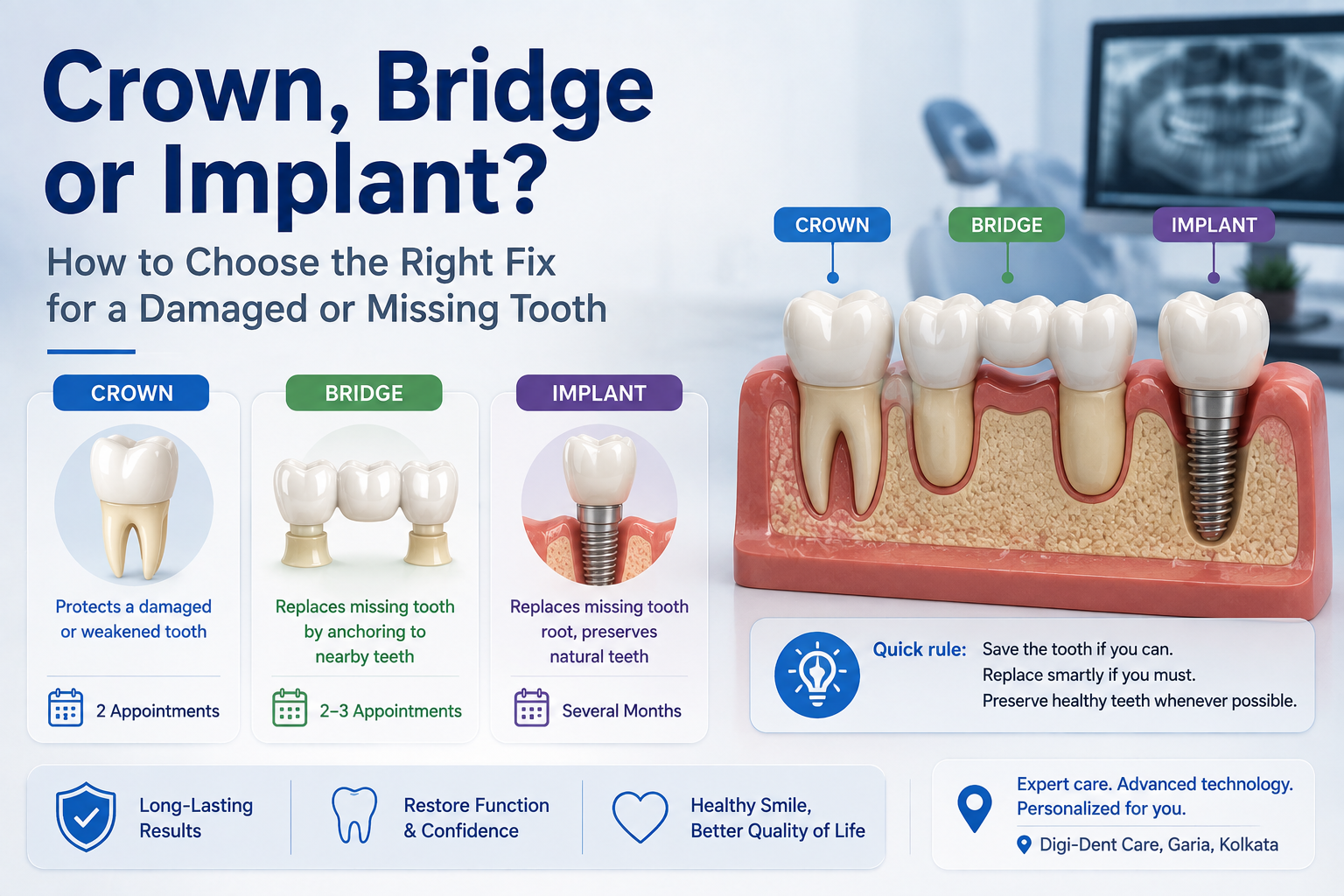
Preparing a tooth for a veneer or crown removes enamel permanently. That is the part patients are right to hesitate over. Simulation and mock-up let you experience the outcome while every option is still open.
It exposes disagreement early
I have had cases where the patient and I clearly pictured different results — and neither of us knew until we looked at a design together. “Natural” means one thing to a 26-year-old and something different to a 60-year-old. The simulation forces that conversation to happen before treatment rather than after.
It plans the treatment backwards, which is the correct direction
This is the technical benefit patients rarely hear about.
Designing the final smile first tells me exactly how much tooth structure needs to be removed — and, just as often, how little. It tells me whether the case needs orthodontics before restorations, whether gum contouring is required to even out the gum line, or whether an implant needs to sit in a specific position to support the tooth we have designed.
Without a design, treatment proceeds forwards from the current situation and hopes to arrive somewhere good. With one, every step is aimed at a defined target.
It usually reduces how much treatment is needed
This surprises people. Once we can see the target, it often becomes clear that four teeth need work rather than eight, or that aligning a tooth orthodontically for a few months avoids removing enamel from it altogether.
A simulation has talked me out of restorative treatment more than once, and I consider that a success.
Where We Use It at Digi-Dent Care
- Digital Smile Design for smile makeovers and cosmetic cases
- Single front crowns and veneers, where matching the neighbouring tooth is critical
- Full mouth rehabilitation, to establish bite height and tooth position before any preparation
- Implant cases, so the final crown is designed before the implant position is chosen — the plan runs from the tooth backwards, not from the bone forwards
- Orthodontic and clear aligner planning, to show projected tooth movement
- Cases where a patient is undecided, which is often the most valuable use of all
What I Am Careful to Tell Every Patient
I would not trust a clinic that presented this as flawless, so here is the honest boundary.
A simulation is a prediction, not a promise. It is a well-informed, data-based prediction — but the mouth is biological. Gum tissue heals and settles slightly differently in different people, ceramic reflects light differently from a screen image, and small refinements at the fitting stage are normal.
Biology sets limits that software does not. A design can show a perfectly aligned tooth in a position where your bone will not support it, or a gum line that would require surgery you may not want. Part of my role is to say plainly: this part is achievable, this part is not, and this part is achievable but I would advise against it.
Anyone can produce a beautiful picture. The design is the easy half. Executing it in ceramic, in a real mouth, so that it fits the margins precisely, functions in the bite, and lasts — that is the half that depends on training, technique and the laboratory. Ask to see finished cases, not only simulations.
More even is not more attractive. The most common request I receive after showing a first draft is to make it slightly less perfect. I take that as a good sign.
What Happened to the Patient
She had four upper teeth treated, not the eight originally discussed — the simulation showed that the outer two only needed reshaping and whitening.
At her review appointment she mentioned, almost in passing, that a colleague had asked whether she had changed her hair.
That is what a well-designed result should do. Not announce itself. Just make people uncertain about what changed.
She had waited four years, through three consultations, for the confidence to proceed. What changed her mind was not a better explanation. It was being able to see it.
How to Choose the Best Smile Designing Service in Garia
If you are comparing clinics, judge the process rather than the equipment. Ask whether you will be shown a simulation before you consent, whether you can wear a trial smile in your own mouth, whether the clinician will tell you plainly what is not achievable, and whether the plan is designed backwards from the finished result. A systematic review published in Cureus found that digital smile design improves communication, reduces errors and raises patient satisfaction — but those benefits depend on it being used as a planning and consent tool rather than a sales aid. Those questions are what separate the best smile designing service in Garia from a clinic with a good camera.
You can see the full range of treatments on our dental services page, read more about the team, or book a consultation at our Garia clinic.
Digi-Dent Care — Digitally Advanced Multispeciality Dental Clinic, Garia
Digital Smile Design · Digital treatment simulation · Intraoral scanning · Ceramic veneers and composite bonding · CAD-CAM crowns · Computer-guided implant planning
Address: Saptatari, A/41, New Scheme, Goshtotala, Garia, Kolkata – 700084
Phone: +91 89102 28151
Email: digidentcare24@gmail.com
Book a consultation: digidentcare.com/dental-clinic-near-me-in-garia
Frequently Asked Questions
1. What is digital treatment simulation?
It is a preview of your treatment result, created before any work begins. Photographs, a 3D scan of your teeth and sometimes a short video are combined into a digital model, and the proposed result is designed on top of it so you can see the before and after side by side.
2. Is it just an edited photo?
No. It is built on measured three-dimensional data from your actual teeth and constrained by your bone, gums and bite. A photo filter can show anything; a proper simulation can only show what is clinically achievable.
3. How is this different from a Digital Smile Design?
They overlap heavily. Digital Smile Design is the established protocol for planning a smile using facial photographs, video and digital design. Treatment simulation is the visual output of that process — the preview you actually see. In practice they are part of the same workflow.
4. Can I try the result in my mouth before deciding?
Yes, and I recommend it. A physical mock-up in temporary material is placed over your existing teeth, with no drilling and no anaesthetic, so you can see and feel the design in three dimensions. It lifts off afterwards and your teeth are unchanged.
5. Does the simulation involve any drilling or discomfort?
No. The simulation itself needs only photographs and a scan — nothing invasive. The optional mock-up is applied over your natural teeth and removed afterwards.
6. How long does it take?
Records usually take a single appointment of about thirty minutes. The design is generally ready within a few days, and we review it together and adjust it as needed before anything is finalised.
7. Will my final result look exactly like the simulation?
Very close, but it is a prediction rather than a guarantee. Gum tissue settles slightly differently in different people, and ceramic behaves differently from a screen image. Small refinements at the fitting stage are normal and expected.
8. Can I ask for changes to the design?
Please do — that is the entire point. Length, width, how even the edges are, how much tooth shows when you smile: all of it can be adjusted before treatment starts. Most patients request at least one change, and most ask for something slightly less uniform.
9. Is this only for full smile makeovers?
No. It is often most valuable for a single front tooth, where the new crown or veneer has to match a natural tooth beside it. It is also used routinely for implant planning and full mouth rehabilitation.
10. Does simulation mean more treatment and higher cost?
Frequently the opposite. Seeing the target often reveals that fewer teeth need treatment than expected, or that aligning a tooth first avoids removing enamel altogether. There is a planning cost, but it commonly reduces the amount of restorative work required.
11. What does the AI actually do?
It automates the measuring and outlining — detecting tooth and gum boundaries, assessing proportion against your facial features, and generating a first-draft design in minutes. Every clinical decision, and every adjustment for how you want to look, is made by the clinician with you.
12. Can everything I see in a simulation be achieved?
Not always, and you should be told so plainly. Bone volume, gum thickness, bite relationship and existing tooth position all set real limits. A trustworthy clinic will tell you which parts of a design are achievable, which are not, and which are possible but inadvisable.
This article is intended for general information and patient education. It is not a substitute for an in-person consultation, examination, or treatment plan. Simulations are clinical predictions, and individual results vary with anatomy, tissue response and treatment choices. The case described is shared with the patient’s permission and identifying details have been changed. Reviewed by the clinical team at Digi-Dent Care, Garia, Kolkata.